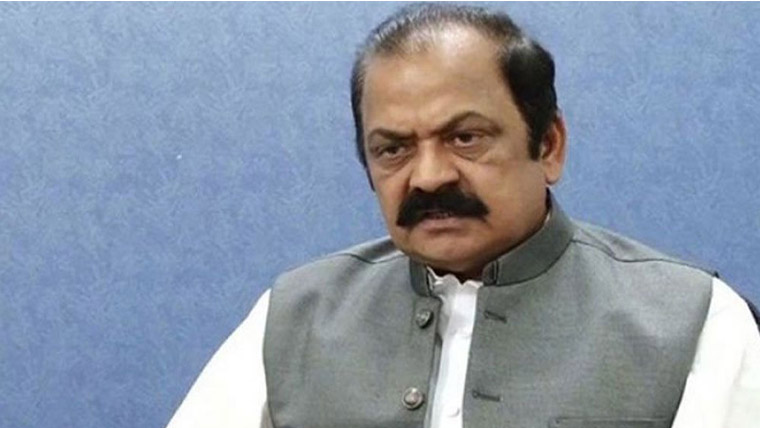
Iislamabad: (Tassawar News) Rana Sanaullah, the Adviser to the Prime Minister on Political Affairs, recently articulated a compelling perspective on the Constitution of Pakistan, positioning it not as an immutable, final decree, but as a dynamic, evolving document essential for national progress and stability. This viewpoint, delivered by the senior Pakistan Muslim League-Nawaz (PML-N) leader, underscores a crucial principle of mature democracy: that fundamental governance frameworks must adapt to the shifting sands of societal needs and changing circumstances. This essay will analyze the nuances of Sanaullah’s statement, exploring the rationale for constitutional amendments, the delicate balance of federal-provincial resource allocation, and the critical role of political dialogue in fostering long-term democratic resilience in Pakistan.
Constitutional Fluidity vs. Sanctity
Sanaullah unequivocally acknowledged the sacred nature of the Constitution, a foundational document that binds the nation. However, he judiciously cautioned against regarding it as the “final word.” This distinction is pivotal, as it moves the discourse away from rigid constitutionalism toward a philosophy of constitutional pragmatism. The very act of the Constitution having undergone 26 amendments since its inception serves as empirical evidence of this necessary evolutionary path. Each amendment, in this context, is not a deviation but a measured response to the nation’s evolving political, social, and economic requirements.
“While the Constitution of Pakistan is undoubtedly a sacred document, it should not be considered the final word. As societies evolve and circumstances change, constitutional amendments become necessary to ensure continued progress and stability.”
This perspective is deeply rooted in the concept of a living constitution, where the text’s meaning and application are perpetually scrutinized and updated to align with contemporary realities. The mechanism for such change, as highlighted by Sanaullah, is the two-thirds majority consensus within the Parliament, which ensures that any alteration is the result of broad political agreement, thus preserving democratic legitimacy. He emphasized that “Political processes never stop—debates and discussions on important national matters are part of a healthy democracy,” framing ongoing dialogue not as a sign of weakness, but as a vital feature of a robust democratic culture.
The Dynamics of the 18th Amendment and Resource Allocation
A significant portion of Sanaullah’s discourse was dedicated to the 18th Constitutional Amendment, a landmark piece of legislation passed in 2010 that significantly devolved powers to the provinces and was a product of rare, widespread political consensus. The PML-N, according to Sanaullah, harbors “no objection” to this amendment, recognizing its core objective: the equitable distribution of resources between the federation and the provinces.
“The 18th Amendment is about equitable distribution of resources between the federation and the provinces. What’s needed now is a balanced approach to ensure both the center and provinces share responsibilities and resources effectively.”
However, while upholding the spirit of the 18th Amendment, the Adviser subtly shifted the focus to the subsequent financial balance of power. He argued for a necessary re-evaluation of the resource-sharing formula, particularly in light of major, non-discretionary federal expenditures. Specifically, he pointed out that national defense and debt servicing should be viewed as shared responsibilities of both the federation and the provinces, rather than an exclusive burden on the federal government. This is a critical point of fiscal governance. Post-allocation for these mammoth obligations, the federal government’s fiscal space becomes severely limited, impeding its capacity for other essential developmental projects.
This necessitates an intricate and sensitive debate on the National Finance Commission (NFC) Award, the constitutional mechanism for resource distribution. The call for a “balanced approach” seeks to ensure fiscal sustainability across all tiers of governance, preventing a scenario where the center is disproportionately strained while provinces, having received a greater share of resources through the 18th Amendment, are perceived as having insufficient corresponding fiscal responsibilities for critical national outlays.
Constitutional Evolution as a Democratic Opportunity
Sanaullah’s remarks, while confirming no immediate plan for a 27th Amendment, served as an unmistakable call for dialogue and consultation among political parties and parliamentarians on various national matters. This proactive stance views constitutional amendments not as a source of political conflict, but as opportunities for reform and progress.
Experts consistently maintain that constitutional evolution is a definitive sign of a mature democracy. It provides a structured, legal mechanism for a nation to effectively address emerging political, social, and economic challenges without resorting to extra-constitutional means or undermining the fundamental, enduring values of the document.
The process of openly debating and inclusively deciding upon potential amendments, as advocated by Sanaullah, is vital for strengthening democratic institutions and securing long-term political stability. It allows the legislative body, which is representative of the popular will, to calibrate the state’s functioning in response to the electorate’s shifting demands and the nation’s systemic challenges.
Conclusion
Rana Sanaullah’s commentary on the Constitution of Pakistan is a sophisticated articulation of the need for adaptive governance. By asserting that the Constitution is a sacred but not final text, he opens the door to a necessary national conversation about reform. His emphasis on fiscal re-evaluation, particularly regarding shared responsibility for defense and debt servicing in the post-18th Amendment era, highlights a significant governance challenge that requires a consensus-driven resolution through the democratic process. Ultimately, the statement is a timely reminder to all political stakeholders that engaging in open debate and viewing constitutional evolution as an inherent feature of a healthy system are paramount to strengthening Pakistan’s democratic foundations and securing its future stability and progress.
Would you like me to elaborate on the history and impact of the 18th Constitutional Amendment in Pakistan?