Kabul: (Tassawar News) The international community has been galvanised by the recent release of the United Nations Assistance Mission in Afghanistan (UNAMA) quarterly report for July to September 2024. This document starkly illuminates the systemic and accelerating deterioration of fundamental human rights for women and girls under the prevailing administration. Despite recurrent and emphatic international condemnation, the report confirms that the incumbent authorities persist in imposing a series of draconian strictures that effectively exclude half the population from public, professional, and educational life. This sustained policy of gender apartheid not only constitutes a grave violation of international human rights law but also simultaneously precipitates a profound socio-economic crisis with multi-generational ramifications.
The Intractable Prohibition on Education
The most immediate and far-reaching of these impositions remains the complete prohibition of secondary and tertiary education for Afghan females, a policy that has remained rigorously enforced since its inception in 2022. This stricture represents a deliberate and comprehensive erasure of women’s pathways to professional development and future civic participation. Compounding this, UNAMA documented the closure of various religious seminaries, or madrasas, and private educational institutions across key provinces, including Badakhshan, Paktika, and Kabul. These closures were reportedly precipitated by the institutions’ attempts to integrate modern academic subjects into their curricula alongside traditional religious instruction, highlighting an intolerance for any form of education that deviates from a narrow, prescribed interpretation. This educational void effectively guarantees the loss of an entire generation of female intellectual and professional capital. The report implicitly warns of the debilitating long-term consequences, positing that the nation’s ability to recover and progress is fundamentally compromised by this systematic intellectual disarmament.
Exclusion from Professional and Humanitarian Spheres
Furthermore, the operational restrictions targeting female employment have been incrementally amplified, creating significant friction within the essential services sector. In 2023, the administration infamously barred female personnel from accessing United Nations offices, a constraint that remains a formidable obstacle to humanitarian relief efforts. More troublingly, the report confirms a critical escalation in 2024, when the ban was extended to fully prohibit women from pursuing medical and dentistry education. This specific delineation effectively terminates the pipeline of professional training for female healthcare workers. This development is particularly alarming given the cultural necessity for female patients to be treated by female practitioners. By simultaneously curtailing the supply of women doctors and restricting access to male doctors, the administration has created a humanitarian choke point, thereby jeopardising public health metrics, especially in maternal and paediatric care.
A Statement on Systemic Violation
The United Nations Assistance Mission in Afghanistan has unequivocally labelled these actions as a blatant disregard for established legal frameworks. The report underscored the moral and legal imperative for global response, stating:
“The rights and dignity of Afghan women continue to be systematically eroded. Without immediate international action, Afghan women’s access to education, healthcare, and employment may vanish entirely.”
This severe assessment underscores the urgency of the situation, differentiating the current crisis from simple policy disagreement and framing it as a trajectory towards total societal exclusion.
Enforcement and the Mahram Mandate
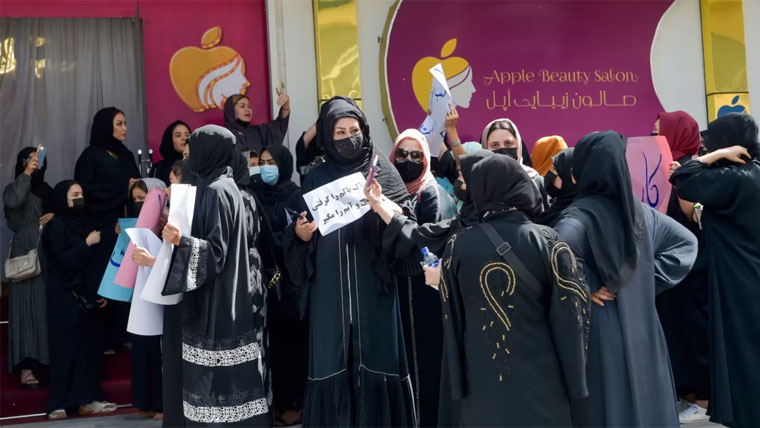
The erosion of fundamental freedoms is tragically underpinned by a rigorous and often violent system of enforcement. The UNAMA report meticulously documented a disturbing rise in physical and psychological abuses, detailing a staggering 456 arbitrary arrests and 44 documented cases of mistreatment of women and girls. These actions were primarily executed for minor dress code infractions or perceived acts of disobedience against local mandates. Such high figures of capricious enforcement clearly demonstrate that the repression of women is not an accidental by-product of governance but rather a core, systematic mechanism of control designed to instil perpetual fear and compliance.
Crucially, freedom of movement and access to healthcare have been severely curtailed by the mandated requirement of a male guardian, or mahram, for women seeking medical consultation with male doctors. This requirement introduces significant logistical and financial barriers, particularly in rural settings or for widowed and single women who may not have an available male relative to accompany them. Consequently, the lack of timely medical intervention due to this prerequisite can lead to preventable morbidity and mortality, making this seemingly regulatory measure a direct threat to life.
Diplomatic Pressure and the Global Response
In light of this calamitous situation, UNAMA has intensified its advocacy, imploring the global community to undertake urgent and concrete diplomatic initiatives to safeguard Afghan women’s inherent fundamental freedoms. Human rights watchdogs worldwide have echoed the sentiment, articulating the situation as nothing less than,
“one of the worst gender-based crises of the 21st century.”
The consensus among analysts is that the current strictures are not merely social limitations but economic self-sabotage. If these bans on women’s participation in the workforce, education, and public life remain intractable, Afghanistan faces an incurable long-term socio-economic collapse, as fully half of the nation’s potential productivity and creativity remains artificially suppressed. The United Nations has specifically called upon member states and humanitarian agencies to intensify diplomatic pressure on the de facto authorities while simultaneously expanding critical support programmes for Afghan women both domestically and internationally.
The overarching conclusion of the quarterly report is unequivocally clear: sustainable peace, political legitimacy, and genuine national progress within Afghanistan are fundamentally unattainable ideals without the full, equitable, and meaningful participation of women in all facets of public life and national governance. The current administration’s policies are creating an environment of deepening instability and unprecedented human suffering, demanding a cohesive and robust global intervention that transcends rhetoric and translates into decisive, tangible action. The future prosperity of Afghanistan hinges entirely upon the immediate and unconditional reversal of these gender-based discriminatory policies.