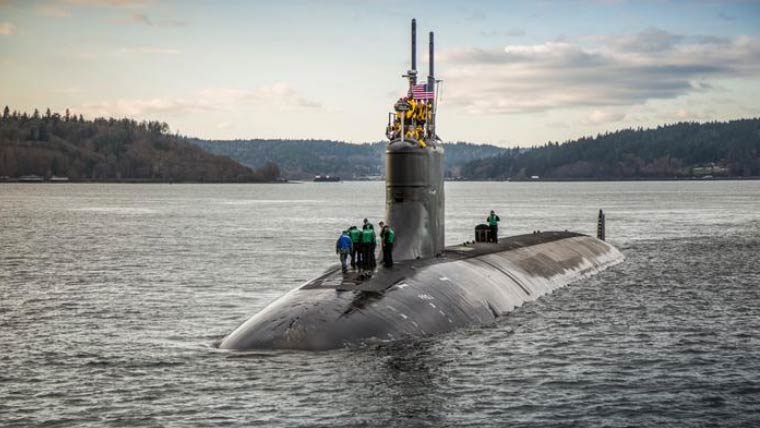
Seoul: (Tassawar News) The Asia-Pacific Economic Cooperation (APEC) Summit in Seoul on October 30, 2025, served as the backdrop for a consequential and transformative development in global security and trade: the United States’ approval of South Korea’s request to construct nuclear-powered submarines. This landmark decision, finalized following intensive, high-level bilateral discussions between U.S. President Donald Trump and South Korean President Lee Jae-myung, signifies a major re-calibration of the regional defence architecture and the U.S. commitment to its East Asian ally amidst escalating security challenges, notably from North Korea and China.
The Anatomy of a $350 Billion ‘Win-Win’ Agreement
The agreement forged between Washington and Seoul is unprecedented in its scale, characterized by a complex structure that meticulously integrates both military cooperation and substantial economic concessions. The financial dimension of the deal mandates that South Korea commit a total of $350 billion in payments and strategic investments towards the United States. This staggering sum is bifurcated into two distinct components, demonstrating a transactional approach to the alliance’s modernisation.
Firstly, $200 billion is earmarked for direct cash installments to the United States, structured as a long-term investment into the American economy, with an annual investment cap of approximately $20 billion to mitigate domestic foreign exchange market risks in Seoul. Secondly, an additional $150 billion is strategically designated for investment into the U.S. shipbuilding sector. This allocation is designed to align with President Trump’s stated objective of dramatically revitalizing the American maritime industry, an initiative he explicitly linked to the project, suggesting that South Korea’s submarines would be built in U.S. shipyards. This simultaneous fulfillment of a foreign policy objective (strengthening an ally) and a domestic economic goal (job creation and industrial revival) led President Trump to characterise the package as a “historic win-win deal.”
In reciprocity for this colossal financial commitment, the United States has agreed to ease trade tariffs on critical South Korean exports, lowering the reciprocal tariff rate, particularly on key sectors like automobiles, to 15% from the previous 25%. Crucially, the United States granted the long-sought permission for Seoul to develop and operate nuclear-powered attack submarines (SSNs). This capability is considered paramount by South Korea for enhancing its sub-surface deterrence posture and achieving greater operational flexibility against sophisticated regional naval threats.
“The Seoul Summit agreement transcends a conventional arms sale; it establishes a new template for alliance maintenance, embedding a reciprocal financial and industrial commitment that directly addresses both American economic objectives and South Korea’s most pressing strategic security needs.”
A Monumental Shift in Defense and Non-Proliferation Policy
The approval for South Korea’s nuclear-powered submarine program represents a monumental policy shift for the United States. Historically, Washington has maintained rigorous restrictions on Seoul’s access to nuclear propulsion technology, primarily citing concerns related to the Nuclear Non-Proliferation Treaty (NPT) and the bilateral U.S.-Korea Atomic Energy Agreement (the ‘123 Agreement’), which prohibits South Korea from independently reprocessing spent nuclear fuel or enriching uranium beyond 20% without U.S. consent. Granting this approval will necessitate a revision, exemption, or alternative arrangement under existing non-proliferation frameworks to secure the necessary low-enriched uranium fuel and technology transfer.
The strategic rationale for this change is undeniably linked to the rapidly deteriorating security environment in East Asia. Analysts widely concur that the move is an assertive measure intended to counterbalance North Korea’s expanding nuclear arsenal, particularly Pyongyang’s own push for submarine-launched missile capabilities, and to address China’s increasing maritime influence across the Indo-Pacific region. Nuclear-powered submarines offer extended underwater endurance, higher speeds, and enhanced stealth, providing South Korea with a vital, persistent platform for surveillance and deterrence that conventional diesel-electric submarines cannot match.
While the specific timeline for development remains officially undisclosed, sources indicate that South Korea’s first indigenous SSN could potentially enter production within the next decade, marking Seoul’s admittance into an elite club of nations with this advanced capability—a list previously including only the five permanent UN Security Council members, India, and Australia (via the AUKUS pact).
Geopolitical Repercussions and Energy Security
Regional observers are unanimous in their view that the authorization of South Korea’s nuclear submarine program is a game-changing geopolitical development. It fundamentally alters the strategic balance among regional powers, particularly China, Japan, and North Korea. The shared military technology is seen as a tangible demonstration of “full trust” by Washington in Seoul’s capacity to responsibly manage highly sensitive defense technology. This strengthening of the U.S.-ROK alliance also places increased expectations on South Korea to assume a more proactive burden-sharing role in regional security, thereby reducing the operational demands on U.S. naval assets.
Beyond the military calculus, the agreement incorporates a substantial energy security component. Seoul has made a definitive commitment to import U.S. oil and liquefied natural gas (LNG) in substantial quantities. This provision not only serves to reduce America’s trade deficit with South Korea—a key economic goal for the Trump administration—but also directly reinforces South Korea’s long-term energy security by diversifying its supply sources and deepening its commercial reliance on the United States.
Conclusion: Modernizing the Alliance through Transactional Strategy
In summation, the agreement forged at the APEC Summit between the United States and South Korea is a powerful illustration of transactional diplomacy utilized to achieve simultaneous strategic and economic objectives. By linking a massive $350 billion financial investment and specific industrial commitments to a groundbreaking policy shift on nuclear technology, the U.S. has modernized its alliance with South Korea, bolstering its conventional deterrence capabilities against North Korean and Chinese maritime threats. This development, which grants Seoul a capability it has pursued for decades, is set to profoundly restructure the strategic landscape of East Asia, confirming Washington’s commitment to its ally while simultaneously ensuring economic benefits for the American shipbuilding and energy sectors. The repercussions of this “historic win-win deal” will undoubtedly resonate across the Indo-Pacific for years to come.