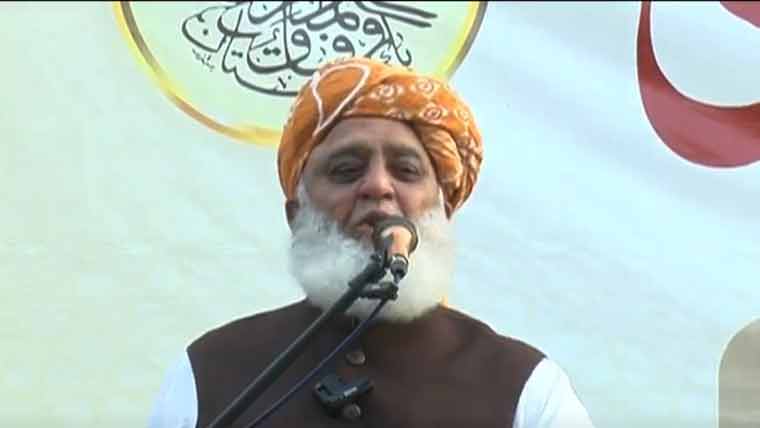
Multan: (Tassawar News) Addressing the Tahaffuz Madaris Diniya Convention in Multan, Chief of the Jamiat Ulema-e-Islam (JUI-F), Maulana Fazlur Rehman, delivered a robust defence of the role of religious seminaries and Pakistan’s foundational Islamic identity. His speech centered on countering what he described as targeted “negative propaganda” orchestrated by external powers aimed at eroding the nation’s religious and ideological moorings.
I. Reaffirming the Constitutional Imperative
A cornerstone of Maulana Fazlur Rehman’s address was a forceful reiteration of Pakistan’s constitutional commitment to Islam. He underscored that the Constitution of Pakistan “clearly states that Islam shall be the state religion of the country” (Article 2 of the 1973 Constitution). This statement serves as a direct challenge to any political or societal forces perceived as attempting to secularise the state or dilute its Islamic character.
The Maulana positioned this constitutional principle as the ultimate legal and ideological shield against foreign agendas, framing the debate over religious influence not merely as a matter of faith but as a fundamental question of national sovereignty and adherence to the country’s founding compact.
“The Constitution firmly establishes Islam as the state religion. Any narrative that seeks to undermine this provision is, by definition, an attack on the very identity and legal framework of the Islamic Republic of Pakistan.”
II. Defending Religious Seminaries Against External Agendas
The central focus of the convention—the defence of religious seminaries (Madaris Diniya)—was passionately taken up by the JUI-F chief. He argued that the current wave of criticism and “negative propaganda” directed against these institutions is not organic but rather part of a coordinated, “foreign agenda” intended to “provoke and mislead the youth.”
Maulana Fazlur Rehman presented the religious seminaries as vital national institutions that successfully insulate the youth from hostile foreign ideologies. He expressed astonishment at the effectiveness of the religious education sector in preserving the youth’s adherence to their faith:
“Foreign agents are anxious about how we managed to protect our young generation from being misled. That is why external forces are now working against us.”
This articulation portrays the Madaris network as a critical front in an ideological war, suggesting that its success in preventing radicalisation or ideological drift is precisely what has made it a target of “external forces.” The implication is that the resistance to this ‘foreign agenda’ is a patriotic duty essential for safeguarding Pakistan’s societal fabric.
III. The Post-9/11 Narrative and the Push for ‘Liberalism’
Maulana Fazlur Rehman situated the current ideological struggle within the broader historical context of global geopolitics following the 9/11 incidents. He asserted that the resultant surge in regional terrorism was weaponised by foreign powers to launch an ideological offensive against the Muslim world.
He claimed that the global powers began aggressively promoting a narrative that encouraged Muslims to “detach from religion and embrace so-called liberalism.” This, in his view, is a subtle form of cultural warfare designed to weaken the Muslim world’s collective identity and political resolve.
The JUI-F chief effectively links this push for ‘liberalism’ to the military and political interventions in other Muslim-majority countries. This narrative is employed to caution the Pakistani populace against accepting foreign-backed reforms or ideologies that could, in his assessment, lead to similar national disintegration.
IV. Condemnation of Regional Intervention and Sectarian Politics
The address extended beyond Pakistan’s borders to strongly condemn what he sees as deceptive foreign policy in the Middle East and South Asia, and, crucially, to warn against internal attempts to sow discord.
A. Critique of Foreign Interventions
Maulana Fazlur Rehman harshly criticized the rationale behind military campaigns in other Muslim nations, arguing that interventionist powers use the guise of peace to achieve destructive goals:
“Afghanistan was destroyed in the name of peace; the same happened in Iraq, Syria, and Palestine — and yet they continue to claim they came for peace.”
This powerful parallel serves to reinforce his argument that global powers operate under a deliberate deception, where stated humanitarian objectives mask a reality of political and national destruction.
B. Warning Against Internal Sectarianism
Bringing the focus back to domestic politics, the Maulana issued a stern warning against leaders who he believes attempt to fracture national unity: he “also said that certain rulers have attempted to create sectarian divisions among the people.” This remark targets domestic political adversaries whom he accuses of deliberately manipulating religious fault lines for political gain, further compromising the nation’s stability in the face of external pressures.
V. Conclusion: An Assertion of Ideological Sovereignty
Maulana Fazlur Rehman’s address at the Tahaffuz Madaris Diniya Convention was a powerful, multi-layered assertion of ideological and institutional sovereignty. The speech deftly wove together three principal arguments: the uncompromising constitutional status of Islam as the state religion, the role of religious seminaries as national bulwarks against “foreign agendas,” and a condemnation of global powers that destabilise Muslim countries under the pretext of promoting ‘liberalism’ and peace.
The convention, therefore, served as a platform for the JUI-F to mobilize its base by framing their efforts as a sacred, constitutional struggle for national identity against both external ideological intrusion and internal political manipulation. The clear message is that the religious establishment remains highly vigilant against any attempts to fundamentally alter Pakistan’s religious foundation or compromise the independence of its institutions.
Would you like a comparative analysis of the JUI-F’s stance on religious education versus the government’s attempts at educational reforms?