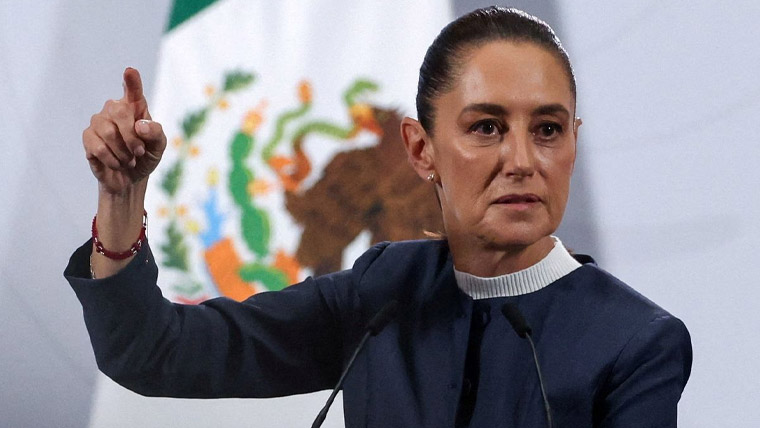
MEXICO CITY (Web Desk): The Republic of Mexico is poised for a significant legislative overhaul concerning gender-based violence, as President Claudia Sheinbaum announced a decisive move to establish sexual harassment as a universally punishable crime across the nation. This bold commitment, articulated after the President herself became the target of a high-profile harassment incident, signals a potentially transformative moment in the country’s ongoing struggle against its pervasive gender violence crisis. The proposed reforms aim to unify disparate state laws and unequivocally codify the criminality of sexual harassment, reinforcing the government’s stance on the non-negotiable nature of women’s dignity and safety.
The Catalyst: A Personal Experience at the Seat of Power
The genesis of this immediate legal initiative stems directly from an alarming encounter involving the 63-year-old President near the presidential palace. According to official accounts, a visibly intoxicated individual reportedly assaulted the President, culminating in an arrest. The details of the incident, which involved the man allegedly touching her shoulder, attempting to fondle her chest and waist, and trying to kiss her neck before security intervened, rapidly became a national talking point, forcing the issue of everyday harassment onto the front pages.
In a powerful demonstration of solidarity and political accountability, President Sheinbaum chose to file a formal complaint. Her rationale, delivered in a candid statement to the press, underscored the systemic nature of the problem:
“If I don’t report it, what message does that send to the rest of Mexico’s women? If it can happen to the President, what about ordinary women?”
This rhetorical question encapsulates the core dilemma faced by millions of Mexican women who endure harassment with little recourse. By treating the incident not merely as a personal violation but as a mandate for systemic change, the President has effectively leveraged her position to champion the cause of all women who have previously felt silenced or unprotected by the existing legal framework. The act of reporting, despite her high office, served as a potent symbolic rejection of the culture of impunity that has long shielded perpetrators of gender-based aggression.
Legislative Commitment: Unifying and Codifying Harassment Laws
President Sheinbaum’s announcement goes beyond mere condemnation; it outlines a clear, multi-state legislative agenda. Her government is now tasked with undertaking a comprehensive review and subsequent unification of harassment statutes across Mexico’s 32 autonomous states. The objective is to eliminate ambiguities and ensure that sexual harassment is uniformly and explicitly defined as a criminal offense from Tijuana to Cancún.
The President emphasized the fundamental principle guiding this reform:
“No one has the right to violate a woman’s personal boundaries. We will make sure the law protects every woman equally.”
This statement hints at the current fragmentation of Mexican law, where definitions, penalties, and even the classification of harassment can vary significantly from one jurisdiction to another, often leading to inconsistent application of justice. The push for legal uniformity is arguably the most crucial technical aspect of the proposed reform, as it seeks to create a predictable and robust legal shield for all women, irrespective of their geographical location.
Furthermore, the President has issued a strong directive to local administrations, urging them to streamline and simplify the reporting process for victims of harassment and sexual assault. This focus on procedural accessibility acknowledges that a strong law is ineffective if the mechanism for enforcing it is unduly complex, intimidating, or fraught with bureaucratic hurdles. The cumulative effect of these legal and procedural enhancements, Sheinbaum asserts, will be to send a “loud and clear message” that the safety and dignity of women are entirely non-negotiable within Mexican society.
Broader Implications: Addressing Mexico’s Femicide Crisis
The legislative drive to criminalize sexual harassment must be viewed within the sobering context of Mexico’s wider gender-based violence epidemic. International human rights watchdogs, including the United Nations, have repeatedly categorized the situation as a dire crisis. Statistical data paints a grim picture: on average, ten women are murdered every single day in Mexico, a staggering figure that places the nation among the world’s most perilous for the female population. This crisis, commonly referred to through the lens of femicide, represents the most extreme manifestation of systemic misogyny and gender inequality.
Activists and civil society organisations, who have tirelessly campaigned for systemic change, view President Sheinbaum’s personal and political stance as a potential watershed moment. While the direct criminalisation of harassment addresses a specific, and often dismissed, category of gender violence, its effective implementation could yield far-reaching psychological and legal effects. It may help dismantle the culture of trivialisation and impunity that allows gender-based aggression to escalate from non-consensual touching to more severe crimes. The hope is that a powerful legal deterrent for lower-level offenses could contribute to a broader societal shift that ultimately curbs the relentless tide of fatal violence.
Stand Both Personal and Political: The Path Ahead
President Sheinbaum’s commitment is deeply rooted in her own history and understanding of the issue, having revealed that she herself experienced harassment during her youth. Her tenure as Mayor of Mexico City already placed her at the forefront of urban policymaking regarding safety, giving her pronouncements additional gravitas. The confluence of her personal history and her current high-ranking office provides a unique, powerful platform from which to drive this challenging reform.
On her social media channels, the President reiterated the profound, universal nature of her motivation:
“This is not just about me; it’s about millions of women who face this every day. We will make sure sexual harassment is punishable by law — everywhere in Mexico.”
This declaration is an affirmation of a political will that appears determined to break with historical precedent. The success of this initiative, however, will hinge critically on two factors: the rigour and clarity of the unified national law, and the commitment of resources to training law enforcement, simplifying reporting mechanisms, and ensuring a justice system capable of handling the inevitable surge in complaints. If effectively executed, this move promises not merely a new law, but the beginning of a genuine cultural and legal transformation in how Mexico values and protects its female citizens.
Conclusion: The Imperative for Effective Implementation
President Claudia Sheinbaum’s decisive action to elevate sexual harassment to a uniformly criminal offense is a commendable and necessary response to a national emergency. Spurred by a personal incident that sharply illuminated the everyday dangers faced by women, the President has instigated a legislative process that holds the potential to reshape gender relations and legal enforcement across Mexico.
While the rhetoric is strong and the political commitment appears unequivocal, the ultimate measure of success will not reside in the announcement itself, but in the efficacy of its implementation. The unification of laws, the simplification of reporting procedures, and the sustained political will to hold perpetrators accountable are the essential, and often most challenging, elements required to translate this promise into tangible safety for millions of ordinary women. This landmark decision could indeed mark the turning point activists have long hoped for, transforming Mexico’s approach to gender-based violence from crisis management to genuine, preventative justice.