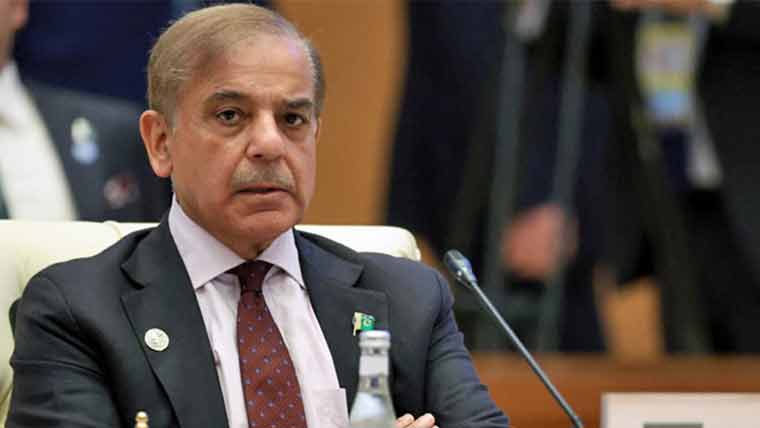
Riyadh (Tassawar News): Addressing a prestigious global gathering, Prime Minister Shehbaz Sharif articulated a pivotal re-evaluation of Pakistan’s developmental trajectory, asserting that the nation has assimilated profound lessons from past economic and administrative missteps. This reflection now underpins a concerted, forward-looking strategy focused on initiating revolutionary structural reforms specifically designed to ensure robust, sustainable economic growth and holistic national development. These significant remarks were delivered during a high-profile roundtable session at the 9th edition of the Future Investment Initiative (FII) Conference in Riyadh, where the central theme for discussion was the philosophical query: “Is Humanity Moving in the Right Direction?”
In his address to the assembled global leaders and investors, the Prime Minister conveyed his unreserved commendation for the ambitious development vision championed by Saudi Crown Prince Mohammed bin Salman. He held this model up as an inspirational paradigm of innovation, transformation, and regional progress. Furthermore, Mr. Sharif meticulously highlighted Pakistan’s inherent strengths, characterising the nation as one abundantly endowed with crucial natural resources and possessing a formidable demographic advantage. He pointed out the strategic asset presented by the youthful structure of Pakistan’s population, with a staggering 60 per cent of its citizens falling under the age of 30, a factor that he views as a major engine for the country’s prospective economic resurgence.
“We have judiciously learned from our historical errors and are now purposefully moving forward with an unwavering, renewed commitment. Pakistan is actively undertaking revolutionary, deep-seated steps to institutionalise transparency, superior good governance, and durable progress,” Prime Minister Shehbaz Sharif pronounced, signalling a definitive break from previous policy patterns.
The Institutionalisation of Anti-Corruption and Digital Governance
The Prime Minister dedicated a significant portion of his address to outlining the administration’s comprehensive reform initiatives targeting core governance challenges, particularly the eradication of systemic corruption and the enhancement of public sector efficiency. A cornerstone of this agenda involves a concerted push towards digital transformation. He announced the complete digitalisation of the Federal Board of Revenue (FBR), the nation’s principal tax collection authority. This monumental overhaul is projected to substantially curtail opportunities for graft and simultaneously enhance the overall transparency and fairness embedded within the tax administration system.
The Prime Minister stated that through extensive digitalisation efforts, the government has achieved “remarkable progress in fundamentally reducing corruption.” He added: “We are absolutely determined to forge a governance model that comprehensively guarantees both integrity and accountability across all administrative tiers.”
This strategic pivot towards technology in tax administration is not merely an efficiency measure; it represents a fundamental commitment to systemic integrity, aiming to build a more formalised, documented economy that inspires greater taxpayer confidence.
Navigating Climate Vulnerabilities and Fiscal Constraints
Prime Minister Shehbaz Sharif proceeded to address the dual challenges posed by acute climate vulnerability and persistent economic strains. He emphatically stated that Pakistan ranks among the world’s top ten countries most detrimentally affected by climate change, facing a relentlessly increasing frequency of severe natural catastrophes, including devastating floods and intense cloudbursts, which have collectively inflicted damages amounting to billions of dollars.
Despite facing significantly limited financial resources, the government continues to accord unwavering priority to rehabilitation and reconstruction efforts for communities severely impacted by these disasters. Concurrently, the Prime Minister used the international platform to issue a compelling plea to the global community, urging for genuinely equitable cooperation and robust mutual assistance across all relevant sectors, especially climate finance and technology transfer.
In a clear articulation of his long-term fiscal philosophy, he remarked: “The practice of continuous borrowing invariably weakens national economies. Humanity can only proceed in the correct ethical and operational direction through the cultivation of mutual cooperation and genuine equality among sovereign nations.”
Technological Adoption and the Pursuit of Economic Sovereignty
In his optimistic forward projection, Shehbaz Sharif underscored Pakistan’s rapid and strategic adoption of both Artificial Intelligence (AI) and other modern technological advancements as crucial instruments for revitalising the nation’s pivotal agricultural and industrial sectors. He elaborated on the potential of AI to revolutionise the agrarian economy.
The Prime Minister noted: “We are actively leveraging Artificial Intelligence to introduce fundamental innovation in the agricultural sphere. Furthermore, our large pool of young Pakistanis is currently undergoing intensive training in advanced agricultural technologies, including specialised programs conducted in partnership with China.”
He stressed that the current administration is deliberately recalibrating its core economic philosophy, shifting the national focus away from reliance on external borrowing toward fostering genuine economic self-reliance. This profound reorientation is predicated on the vigorous promotion of indigenous innovation, the support of entrepreneurship, and the boosting of local productivity and export-led growth.
“Pakistan is diligently and tirelessly working to achieve a state of standing entirely on its own feet. We are confident that with sustained hard work and unshakeable faith in Providence, we will successfully transform Pakistan into a compelling success story,” the Prime Minister asserted, expressing his utmost conviction in the nation’s capacity for fundamental change.
Conclusion
Prime Minister Shehbaz Sharif’s address at the FII Conference served as a comprehensive statement of the government’s renewed commitment to structural economic reform and governance transformation. His emphasis on learning from past errors, leveraging the nation’s youth demographic, and strategically employing digital and AI technologies demonstrates a forward-looking approach aimed at creating a resilient and sustainable economic model. Crucially, the articulation of a desire to move away from perpetual borrowing towards self-reliance, coupled with an appeal for global equity in the face of shared climate challenges, positions Pakistan as a nation seeking responsible economic sovereignty and meaningful international partnership. The success of this ambitious vision ultimately hinges on the government’s determined and transparent execution of the highlighted reforms, particularly the full digitalization of key institutions, which is essential to cementing public trust and attracting the sustained foreign investment necessary for achieving long-term peace, prosperity, and national progress.